When you are architecting conversational systems for millions of users—like a major tier-1 telecommunications network—the challenge isn't "getting a smart answer." The challenge is deterministic state integrity across a massive web of microservices.
You don't solve that with better prompt engineering. You solve it with Multi-Agent Decision Processes (MDP).
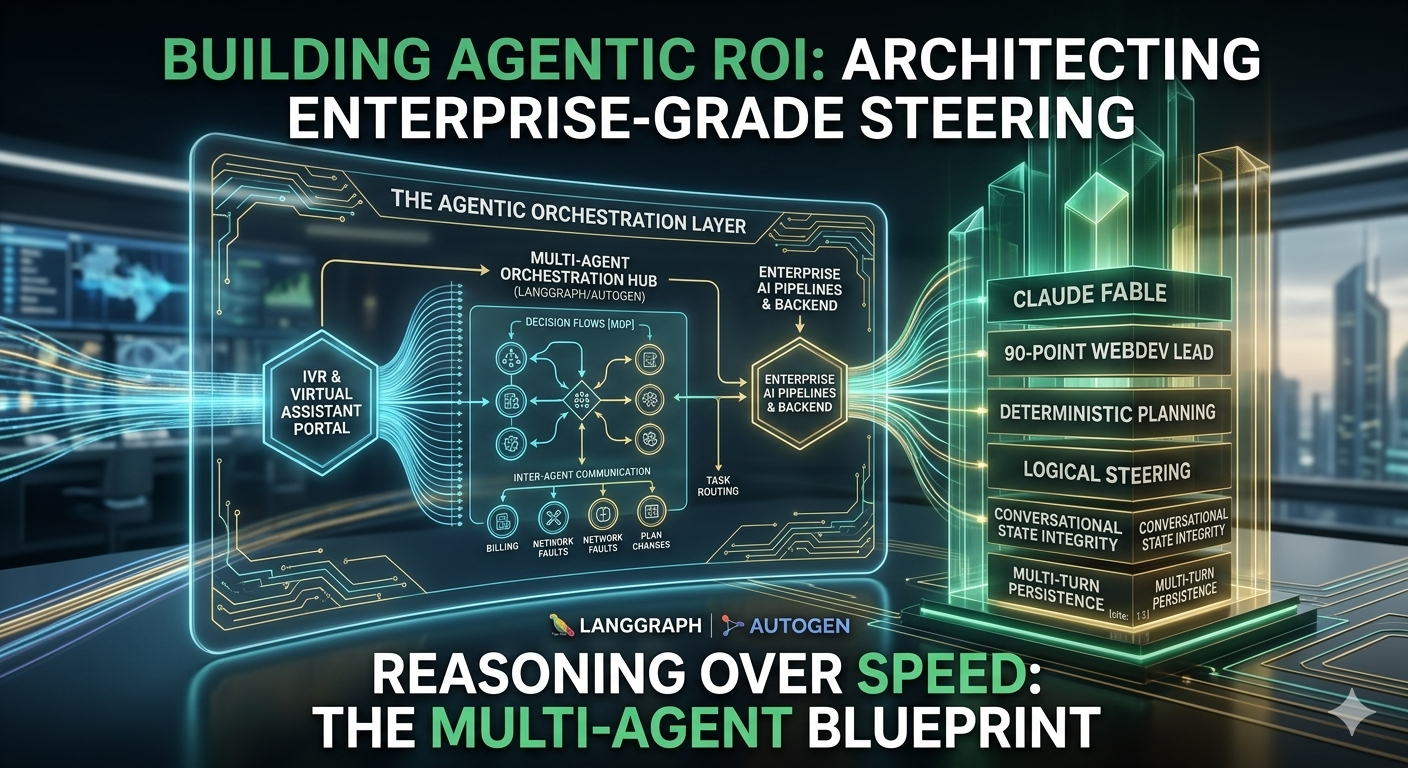
Here is how an enterprise-grade agentic architecture actually looks under the hood when replacing legacy IVR and virtual assistants with a hardened LangGraph or AutoGen pipeline:
1. The Orchestration Layer (The Router)
Instead of a single large model attempting to parse billing queries, network faults, and account upgrades simultaneously, you deploy a central, lightweight orchestrator. This router uses strict tool-calling structures to handle intent classification and maps the user's session state dynamically to specialized sub-agents.
2. State-Isolated Sub-Agents
The Billing Agent: Holds isolated context window memory to read invoice structures securely without exposing PII to the rest of the network.
The Faults Agent: Interacts with real-time network telemetry databases to check regional cell tower outages or physical line faults in parallel.
The Escalation Agent: Monitors conversational sentiment and multi-turn state drift. If intent accuracy dips below a 92% confidence score, it forces a seamless live-agent handoff.
3. Observability & Hallucination Defense
In production, your biggest bottleneck is data drift and uncontrolled automation. Enterprise architectures require real-time evaluation harnesses directly over the inference streams. Every state transition must run through automated hallucination detection metrics before the generated tokens hit the frontend customer UI.
The Bottom Line:
Enterprise AI isn’t a playground for single-file wrappers anymore. It’s a complex systems-engineering discipline that requires building strict, fenced guardrails and predictable routing behaviors inside existing cloud security perimeters.
We are moving away from simple question-answering bots and moving toward Autonomous Execution Command Centers that run inside systems companies already trust.
How is your engineering team currently structuring inter-agent communication and state routing to prevent multi-turn memory decay?
Let’s talk architecture in the comments.
#AIArchitecture #LangGraph #EnterpriseAI #TelcoTech #MultiAgentSystems #SoftwareEngineering #CTO