🚨 I wouldn't trust an AI agent with my company...
...unless it had Guardrails.
That might sound strange coming from an AI Engineer.
Everyone is talking about autonomous AI agents that can:
📧 Send emails
📂 Access company documents
📊 Analyze business data
⚙️ Call APIs
💰 Complete business workflows
But very few people are asking the most important question.
What happens when the AI makes the wrong decision?
Imagine this...
An AI agent accidentally sends confidential information to the wrong client.
Or deletes a production record.
Or approves a transaction it shouldn't.
It only takes one mistake.
That mistake could cost thousands of dollars—or something even more valuable:
Trust.
This is exactly why Guardrails have become one of the most critical components of modern Agentic AI.
Think of Guardrails as the seatbelt for AI agents.
They don't stop the car.
They make sure everyone arrives safely.
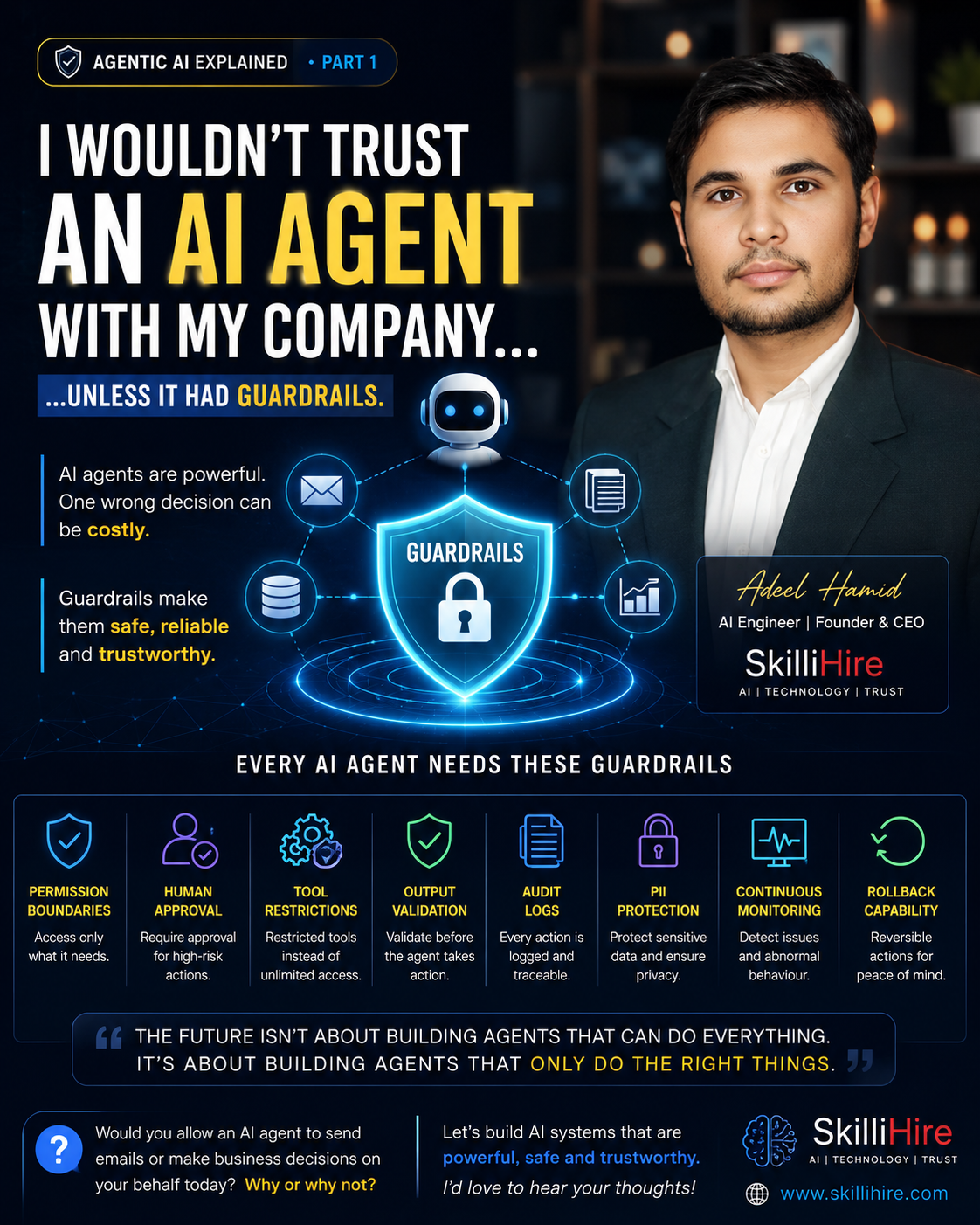
A production-ready AI agent should never operate without:
✅ Permission boundaries (only access what it needs)
✅ Human approval for high-risk actions
✅ Restricted tool access instead of unlimited freedom
✅ Output validation before taking action
✅ Audit logs so every decision is traceable
✅ PII protection and secure data handling
✅ Continuous monitoring to detect abnormal behaviour
The future of AI isn't about building agents that can do everything.
It's about building agents that only do the right things.
As AI becomes more autonomous, trust will become a bigger competitive advantage than intelligence.
This is why I believe the next generation of AI Engineers won't just build smarter agents.
They'll build safer ones.
💬 Would you allow an AI agent to send emails or make business decisions on your behalf today?
Why or why not?
I'd genuinely like to hear your thoughts.
#ArtificialIntelligence #AgenticAI #Guardrails #ResponsibleAI #LLM #GenerativeAI #AIEngineering #MachineLearning #DataScience #MLOps #AI #Innovation #CyberSecurity #Startups #EnterpriseAI