Every production-grade AI agent breaks down into the exact same 3 pillars. If you miss one, you aren't building an agent—you're just building a fragile script.
As the industry rushes to deploy autonomous systems, I see a lot of confusion about what actually constitutes an "Agent" versus a standard LLM chain.
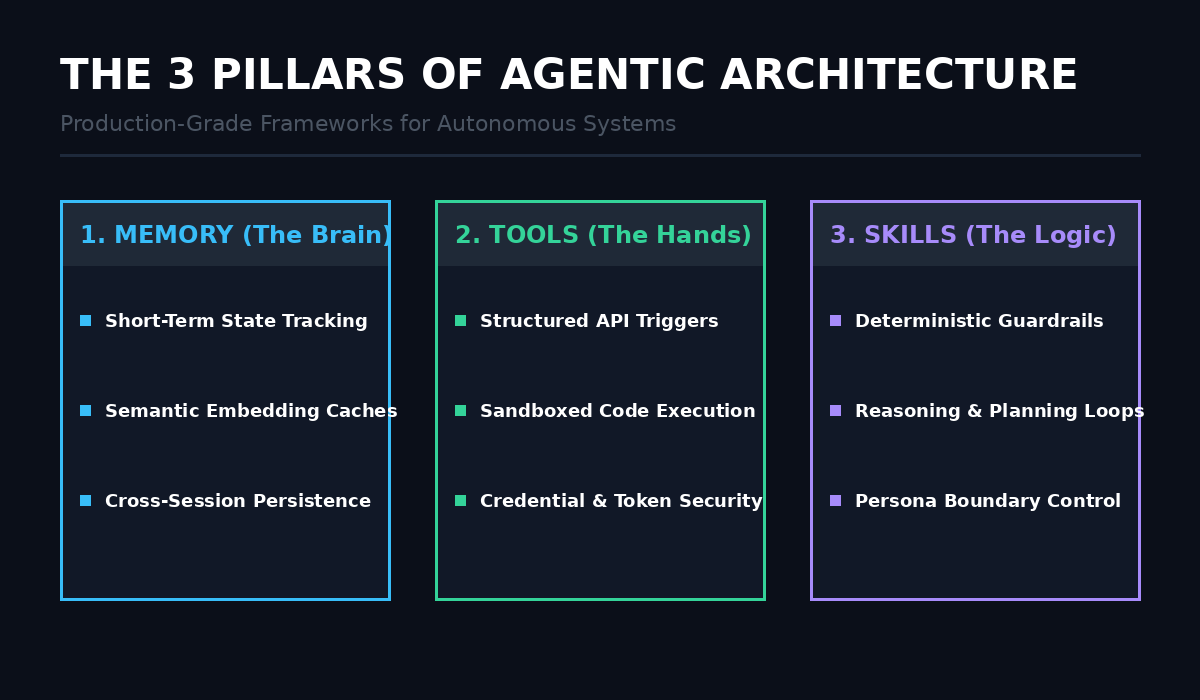
When you strip away the marketing hype of frameworks like LangGraph, AutoGen, or CrewAI, an agentic architecture relies entirely on the interplay of three core primitives:
1. The Core Brain & Planning (Memory)
An agent needs to know who it is, what it has done, and what it needs to do next. This requires two distinct memory tracks:
Short-Term Memory: In-context learning and multi-turn state persistence that tracks the immediate task execution path.
Long-Term Memory: Vector embeddings or external databases (like Supabase or specialized semantic caches) that allow the agent to retain user preferences, historical outcomes, and system constraints across separate sessions over months.
2. The Capabilities (Tools)
A brain without hands is paralyzed. Tools are the APIs, database connectors, and local execution sandboxes that give the agent agency. Through structured tool-calling (like WebMCP standards), the model decides when to execute a Python script, query a SQL database, or hit a third-party CRM API to mutate state in the real world.
3. The Cognitive Engine (Skills)
Skills are the deterministic behavioral patterns, prompt strategies, and fine-tunes optimized for specific roles. A "Frontend Developer Agent" and a "DevOps Monitoring Agent" might use the exact same foundational LLM backend, but their skills—their specialized reasoning logic, planning loops (like ReAct or Plan-and-Solve), and evaluation guardrails—are completely distinct.
The Architect's Reality Check:
The magic doesn't happen in the individual pillars. It happens in the orchestration framework that syncs them together. If your agent's tools don't update its long-term memory, or if its skills lack the safety policies to constrain tool execution, the architecture collapses in production.
Stop trying to build "do-everything" wrappers. Focus on designing tight loops where isolated skills use explicit tools to manage a predictable memory state.
If you are building agentic workflows right now, which of these three pillars is giving your engineering team the most friction to stabilize at scale? Let's talk system design in the comments.
#AIArchitecture #AIEngineering #AgenticAI #LangChain #SystemDesign #SoftwareArchitecture #CTO #TechFounders