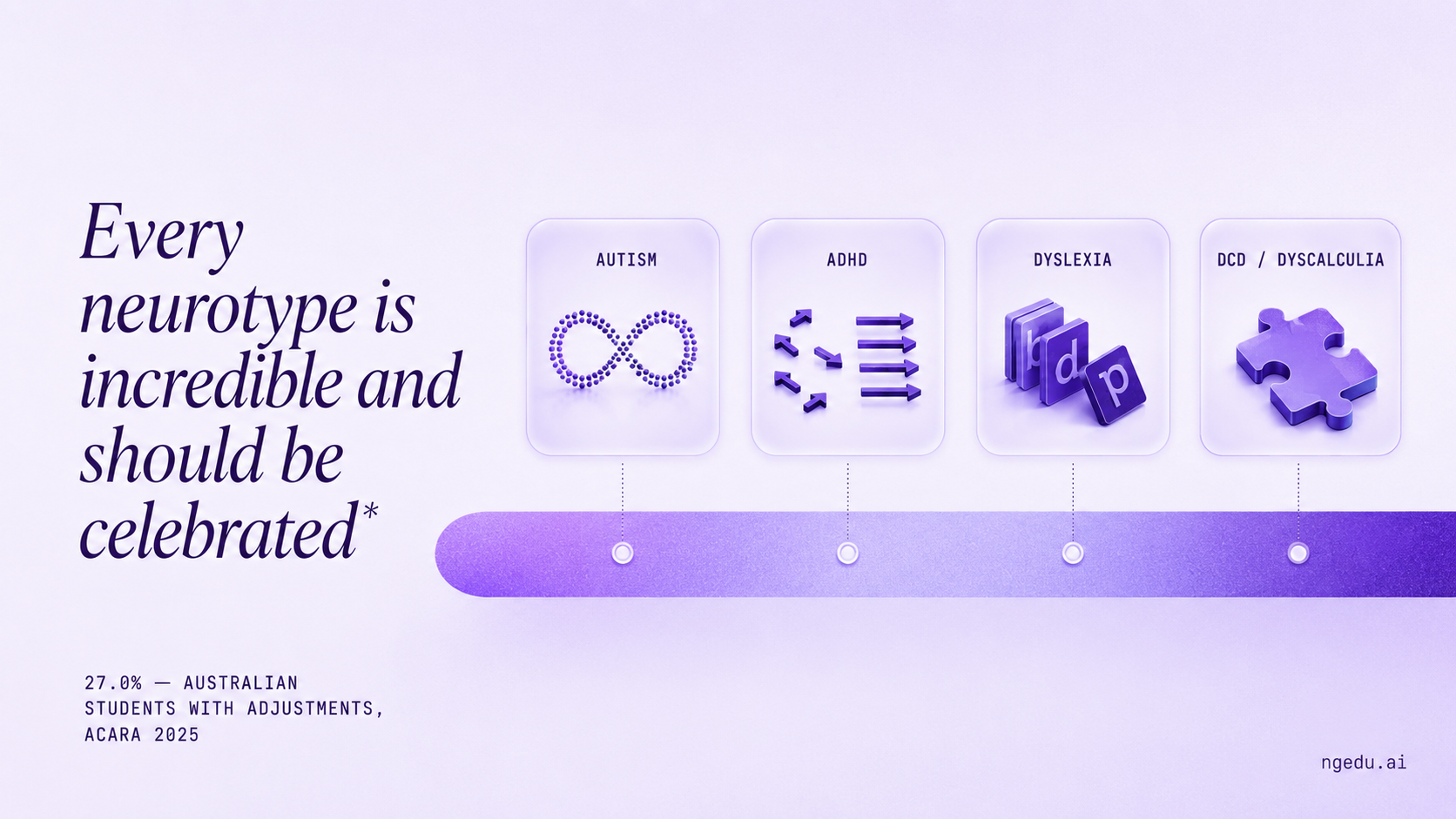
In 90 seconds
- 27.0% of Australian school students received an educational adjustment for disability in 2025 (ACARA) — up from 18.0% a decade earlier.
- Most evidence on AI tutoring is on neurotypical learners. The neurodivergent-specific literature is still thin, short and mostly extrapolated.
- Three things genuinely help: text-to-speech for dyslexia, task decomposition for ADHD/autism, and hybrid human + AI tutoring.
- Four real risks: metacognitive laziness (Fan et al. 2024), voice ASR fails for atypical speech, parasocial attachment, and vendor overclaiming.
- The Australian Framework for Generative AI in Schools (June 2025) and the NDIS AI-AT Framework (2022) are the policy floors. Use them.
Editorial note. This article is general information based on a review of public research, government guidance and clinical literature current at the date shown. It is not legal, educational, medical or therapeutic advice. Diagnostic decisions and AT funding choices should be made with qualified professionals (paediatrician, psychologist, OT, speech pathologist) who know your child. Always confirm NDIS funding, school adjustment processes and registration rules with the relevant Australian authority.
The headline number most parents have not yet heard
In 2025, 1,125,502 Australian school students received an educational adjustment due to disability — 27.0% of total enrolments, up from 18.0% a decade earlier (ACARA, National Report on Schooling 2025). Of those adjustments, 53.0% supported students with cognitive disability and 36.3% supported students with social-emotional disability — the two categories where the autism, ADHD and specific learning disability (SLD) cohorts predominantly sit.
That is roughly one in four Australian school students receiving some form of educational adjustment. For comparison, up to one in ten Australians has a learning disability (Healthdirect Australia), and about one in twenty Australian children is diagnosed with ADHD (Murdoch Children's Research Institute) — figures clinicians describe as still likely to underestimate true prevalence, particularly in girls and women. For families navigating these systems day-to-day, the homeschool registration and adjustment process by state is a useful starting reference.
The other shift, less talked about: generative AI is now in front of these children every day. Australian Education Ministers endorsed the 2024 Review of the Australian Framework for Generative AI in Schools in June 2025. The NDIS published a Framework for AI-Enabled Assistive Technology Supports back in 2022. Khanmigo, Read Along, Immersive Reader, Goblin Tools and a hundred smaller voice-first agents are already in homes.
So the question parents, OTs and advocates are asking — quietly, because the answers have been thin — is the right one: does any of this actually help neurodivergent Australian kids learn?
This piece is an attempt at an honest answer.
What we know about Australian neurodivergent learners in 2026
Three reference points are worth pinning down before we touch any evidence on AI. (For a wider survey of what 50+ recent studies say about kids and AI generally, see our AI & kids learning research review.)
One. Prevalence numbers are rising, but the increase largely reflects better recognition, broader diagnostic criteria and long-overdue inclusion of girls, women and underrepresented groups — not necessarily a true increase in neurodivergence. This matters for AI: tools trained on neurotypical data inherit the same blind spots.
"Our screening tools and diagnostic process are really good at identifying more individuals who might be neurodivergent — early datasets mostly captured whoever made it to referral clinics, which was often boys with externalised behaviours, so lots of people were missed."
— Dr Laura Roche & Dr Patrick Skippen, HMRI, March 2026
Two. ADHD in Australia is recognised as a neurodevelopmental disorder with onset before age 12, requiring at least 6 of 9 inattentive or hyperactive-impulsive symptoms for diagnosis in children (Australian Evidence-Based Clinical Practice Guideline for ADHD, AADPA). The clinical population estimate sits at 6–10% of children and adolescents internationally. For autism, ABS estimates the autistic population in Australia at over 290,000 (2022 release), with the highest prevalence in school-age children. Specific learning disorders — dyslexia, dysgraphia, dyscalculia — are recognised under the Disability Discrimination Act 1992 and, importantly, are lifelong: per Healthdirect, "learning disabilities cannot be cured" alone — they require accommodations and tools that work with the brain a child has.
Three. Co-occurrence is the rule, not the exception. Estimates from AUSPELD, AADPA and the Autism CRC consistently show that around half of children with one neurodevelopmental diagnosis meet criteria for at least one other (ADHD + dyslexia; autism + ADHD; dyslexia + DCD). Single-diagnosis advice rarely fits a real child, and the AI evidence base, mostly built on neurotypical or single-condition cohorts, often does not generalise.
Hold those three in mind. They are the lens through which we read everything that follows.
Where AI tutoring genuinely helps — three evidence-supported mechanisms
The 2025 systematic review of intelligent tutoring systems (ITS) in K–12, published in npj Science of Learning, found generally positive effects on academic outcomes, with the caveat that effect sizes vary widely and that the advantages over high-quality non-intelligent tutoring are smaller than vendor claims suggest. The 2025 OECD working paper Leveraging AI to Support Students with Special Education Needs makes a stronger and narrower claim: AI offers genuine, non-trivial accessibility gains for specific tasks for specific learners. Three mechanisms stand out.
Mechanism 1 · Strong evidence
Removing the bottleneck of decoding
For dyslexic readers, the rate-limiting step is often phonological decoding, not comprehension. Text-to-speech and immersive reading tools decouple the two: the child listens to grade-level content while their decoding skills (still taught explicitly via structured-synthetic phonics offline) catch up. ATIA's 2020 review of TTS as a reading aid, the 2018 ERIC meta-analysis, and Microsoft's Immersive Reader research base consistently report comprehension gains for students with reading difficulties.
Bottom line: TTS is the single highest-leverage AI accommodation for a dyslexic child, and is straightforwardly fundable as AT under most NDIS plans where AT is reasonable and necessary.
Mechanism 2 · Emerging evidence
Externalising executive function
For ADHD and autistic learners with executive-function differences, the cost is rarely "I don't know what to do" — it is getting started, breaking down, and sequencing. AI agents that explicitly externalise these steps (Goblin Tools' Magic ToDo being the most-cited consumer example) operationalise a strategy OTs and ADHD coaches have used for decades: parking task-decomposition outside the working memory of the child.
Bottom line: This use does not replace teaching — it removes a barrier between the child and the teaching they have already had. The 2025 OECD paper notes this "scaffolded autonomy" pattern shows promise for SEN learners, while flagging that long-term studies are missing.
Mechanism 3 · Strongest 2024–2026 RCT signal
Hybrid human–AI tutoring, not pure AI
The strongest 2024–2026 efficacy signal in K–12 AI tutoring at large scale is not "AI alone replaces tutor" — it is hybrid human-AI tutoring. The Stanford-backed Tutor CoPilot RCT (arXiv:2410.03017) deployed AI assistance across 900 tutors and 1,800 K–12 students and found measurable improvements when AI augmented human tutors, particularly less-experienced ones. Stanford's NSSA 2026 research note replicates the finding in two further math RCTs.
Bottom line: The strongest predictor of intervention success across autism, ADHD and SLD literature is relational — a trusted adult who knows the child. AI can multiply the bandwidth of that adult; it has not, as of June 2026, replaced the relationship. This is the model the State of Homeschooling in Australia 2026 report identifies as dominant for the ~45,000 AU families now homeschooling, and it also reframes the cost question we cover in our AI tutor vs private tutor vs online school cost breakdown — the comparison is rarely either/or.
Where AI tutoring fails or harms — four honest caveats
Anyone who tells you AI is safe and effective for neurodivergent kids and stops there is selling you something. The following four findings are well-evidenced enough that any parent decision should incorporate them.
Caveat 1 · Measured RCT effect
Metacognitive laziness is real
The most important paper for parents to understand is Fan et al. (2024), "Beware of Metacognitive Laziness" — a randomised study of 117 university students working on a writing task across four conditions (ChatGPT, human expert, writing-analytics tools, no support).
"ChatGPT group outperformed in the essay score improvement but their knowledge gain and transfer were not significantly different... AI technologies such as ChatGPT may promote learners' dependence on technology and potentially trigger metacognitive laziness."
In plain English: better outputs without better learners. For a child whose specific challenge is writing under executive-function load, this is exactly the failure mode you want to avoid — a tool that finishes the work the brain was meant to practise. Reinforced by Georgiou (arXiv:2507.00181) and Pitts et al. (arXiv:2506.13845). Mitigation: mastery gates and forced retrieval — the child demonstrates learning before the AI moves on.
Caveat 2 · Accessibility failure
Voice-first AI fails for atypical speech
The single most widely promoted use case with younger autistic children is voice-first interaction. The evidence is clear that automatic speech recognition is meaningfully less accurate for children's voices than for adults' (MDPI Applied Sciences, 2022 systematic review), further less accurate for autistic children's speech (Park et al., Interspeech 2025), and for dysarthric speech (Alsayegh & Masood, arXiv:2512.17474, 2025).
The practical effect: a voice-first AI agent can mis-hear an autistic child's request, then deliver a confidently wrong response. That is a worse failure mode than text-first interaction, because the child often does not know the agent has misheard. Recommendation: co-present for the first dozen interactions; switch to text-first if accuracy is patchy. NDIS-funded AAC devices with personalised speech models remain more reliable than off-the-shelf voice agents for children with significant speech differences.
Caveat 3 · Safety & bias
Parasocial attachment & vulnerable-user risk
The NSPCC's January 2025 report Viewing Generative AI and Children's Safety in the Round documents a familiar list of risks: AI-generated CSAM, bullying, harassment, grooming, extortion and misinformation. Less-discussed but salient for neurodivergent users: parasocial attachment to AI companions, particularly in autistic users for whom predictable, non-judgemental conversation is genuinely soothing.
This is not a reason to deny access. It is a reason to frame AI agents as tools, not friends, with the same explicit teaching about parasocial relationships good schools now do for streamers and influencers. Australia's eSafety Commissioner submission makes the same point in policy language.
Caveat 4 · Evidence gap
The ND-specific evidence base is thin
The 2025 systematic review of neurodiversity in computing education (Zastudil et al., arXiv:2504.13058) and the 2025 systematic review of harms in generative AI in computing education (Bernstein et al., arXiv:2510.04443) reach the same uncomfortable conclusion: there are very few rigorous, longitudinal studies of AI tutoring with neurodivergent learners specifically.
Anyone making strong claims about effect sizes for autistic, ADHD or dyslexic children specifically is — at best — extrapolating. At worst, marketing.
Australian policy context — what's actually written down
Three documents matter most for any conversation with a school, an OT, or an NDIS planner.
Department of Education · Endorsed June 2025
Australian Framework for Generative AI in Schools
Six principles: teaching and learning, human and social wellbeing, transparency, fairness, accountability, privacy/security/safety. Anticipates use by school leaders, teachers, support staff, parents and students. The right reference when raising AI questions with a school's Learning Support team or under an IEP.
NDIS / CSIRO · 2022
Framework for AI-Enabled Assistive Technology Supports
Six principles: user experience, value, quality, safety, privacy/security, human rights. The right reference for funding conversations about AI-enabled AT — speech-to-text, AAC, immersive reading and similar.
eSafety Commissioner · 2023
Classroom resources & GenAI submission
Establishes the floor for child-safety expectations and is increasingly cited in school AI policies. The Disability Standards for Education 2005 and Australian Curriculum v9's Student Diversity provisions establish the legal basis for "reasonable adjustments" that AI can — and should — be considered to provide.
A practical protocol — eight things parents and schools can implement this term
Informed by the evidence above plus the 50-prompt curriculum-aligned AI prompt library we maintain for Australian families. Deliberately tool-agnostic.
Start with AT, not generative AI
TTS for dyslexic readers, predictive text for dysgraphic writers, structured timers for ADHD. Decades of evidence; uncontroversially fundable as AT. Generative AI sits on top of a working AT foundation, not in its place.
Use the curriculum-safe prompt formula
Role + Year level (AC v9) + Achievement standard + Output format + safety wrapper. Generic ChatGPT defaults to US phonics order and imperial units — none of which serves a child whose school books say otherwise.
Force retrieval before generation
After every AI explanation, the child answers a question from memory. The technical fix for Fan et al.'s metacognitive-laziness pattern.
Cap sessions by neurotype
ADHD: a focused 12-minute sprint can outperform a flagging 40-minute one. Autistic learners may prefer longer single-topic blocks with fewer transitions. Don't apply neurotypical caps.
Parent co-presence at onboarding
First dozen interactions watched live, particularly for voice-first agents with autistic children. Switch to text-first if the agent is mishearing.
Document for IEPs & NDIS
Weekly portfolio of what the AI did vs. what the child did. Doubles as evidence for IEP review meetings and AT funding under "reasonable and necessary" criteria.
Surface, don't hide, AI use
Treat the AI like a calculator or teaching assistant: legitimate, named, visible. Hidden use is the path to academic-integrity issues and worse parasocial outcomes.
Fortnightly misconception review
Look at what the child got wrong twice in the same way, not the completion rate. That is where targeted human or therapy time goes next.
Tools by category — what the evidence actually supports
The table below is deliberately conservative. It includes only tools where the underlying mechanism has independent published evidence behind it for neurodivergent learners or near-neighbours.
Where the research is still thin — be honest about it
Unknown unknowns
If we are honest, we do not yet have strong empirical answers on:
- Long-term effects of daily AI tutoring on cognitive development in neurodivergent children.
- Differential outcomes by neurotype across multi-year cohorts.
- Australian replication of the major US/EU findings.
- Early-childhood (3–5) effects of voice-first conversational agents.
The OECD's 2025 SEN paper, the npj 2025 systematic review and the AU evidence reviews currently being funded all converge on the same conclusion: the next three years of research will probably matter more than the last three. That is a reason for cautious early adoption with strong documentation, not for either evangelism or refusal.
Editorial note
This article reflects the author's reading of public research and Australian guidance current at the time of writing. It is general information, not legal, educational, medical or therapeutic advice. Diagnostic and AT-funding decisions should be made with qualified professionals who know your child. Always confirm registration rules, NDIS funding, and school adjustment processes with the relevant Australian authority.
Selected sources
- ACARA — National Report on Schooling in Australia 2025: School students with disability — acara.edu.au
- Healthdirect Australia — Learning disabilities (Aug 2025) — healthdirect.gov.au
- AADPA — About ADHD — adhdguideline.aadpa.com.au
- HMRI — The real story behind rising ADHD and autism diagnoses (Mar 2026) — hmri.org.au
- Australian Framework for Generative AI in Schools (Jun 2025) — education.gov.au
- NDIS — Framework for AI-Enabled AT Supports (2022) — ndis.gov.au
- eSafety Commissioner — Submission to the Inquiry into Use of GenAI in the Australian Education System (2023)
- Fan et al. — Beware of Metacognitive Laziness (BJET / arXiv:2412.09315, 2024) — arxiv.org/abs/2412.09315
- Tutor CoPilot RCT — Stanford et al. (arXiv:2410.03017, 2024)
- NSPCC — Viewing Generative AI and Children's Safety in the Round (Jan 2025) — learning.nspcc.org.uk
- OECD — Leveraging AI to Support Students with Special Education Needs (2025)
- npj Science of Learning — Systematic review of AI-driven ITS in K–12 (2025)
- UNICEF Innocenti — Guidance on AI and Children 3.0 (2025)
- UNESCO — Guidance for Generative AI in Education and Research (2023, updated 2026)
- ATIA — Keelor et al., TTS as a reading aid (2020); MDPI Applied Sciences — ASR for children's speech systematic review (2022); Park et al. — ASR for autistic speech (Interspeech 2025)
About the author
Written by the editorial team at NextGen Schooling, an Australian curriculum-aligned AI homeschooling and adaptive learning platform for K–12 families, with input from clinical and educator advisers. NextGen Schooling builds tools that map to the Australian Curriculum v9 and operate under the federal Australian Framework for Generative AI in Schools.